A few things we’re proud of
Technically, we are young but by all metrics, we have established a strong foothold in our domain.
Some worthwhile which bears testimony to what we claim
Global Assessment Report 2025
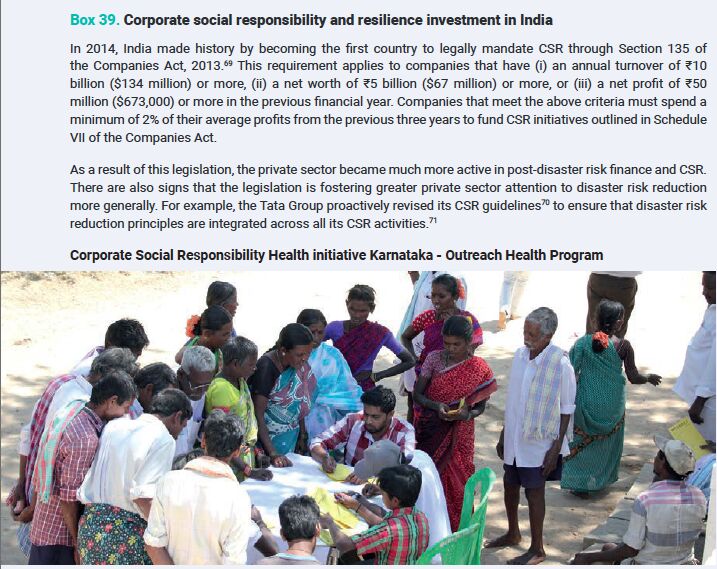
As disasters grow in frequency and intensity (especially those triggered by climate change), disaster risk reduction (DRR) and climate action have become non-negotiable for a resilient tomorrow. Globally, the economic toll of disasters is soaring, yet we’ve long underestimated the value of investing in DRR upfront—both in savings and sustainability. Enter India’s mandatory Corporate Social Responsibility (CSR) framework: a groundbreaking mechanism with untapped potential to fund DRR efforts.
The United Nations Office for Disaster Risk Reduction (UNDRR)’s Global Assessment Report (GAR) 2025, themed around financing our future, spotlights India’s CSR ecosystem as a standout example. But there’s a catch—current CSR spending heavily favours ex post affairs, driven by legislative limitations and a the limited & parochial understanding of disaster risk management (DRM). The data reveals stark resilience gaps, showing that India’s CSR model could be a game-changer if decision-makers shift focus – understand, interpret and prioritise DRR they way it should be. Take the Tata Sustainability Group, for instance—they’ve woven DRR into the fabric of their CSR initiatives, proving resilience goes beyond cleanup and recovery.
We’re thrilled that our co-founder Dr. Repaul Kanji and Tanmay Gound from Confederation of Risk Reduction Professionals (CRRP) India, unpacks these insights in GAR 2025.
Dive into the full report at https://www.undrr.org/gar/gar2025 to explore how CSR can power DRR, or connect with us for the in-depth study!
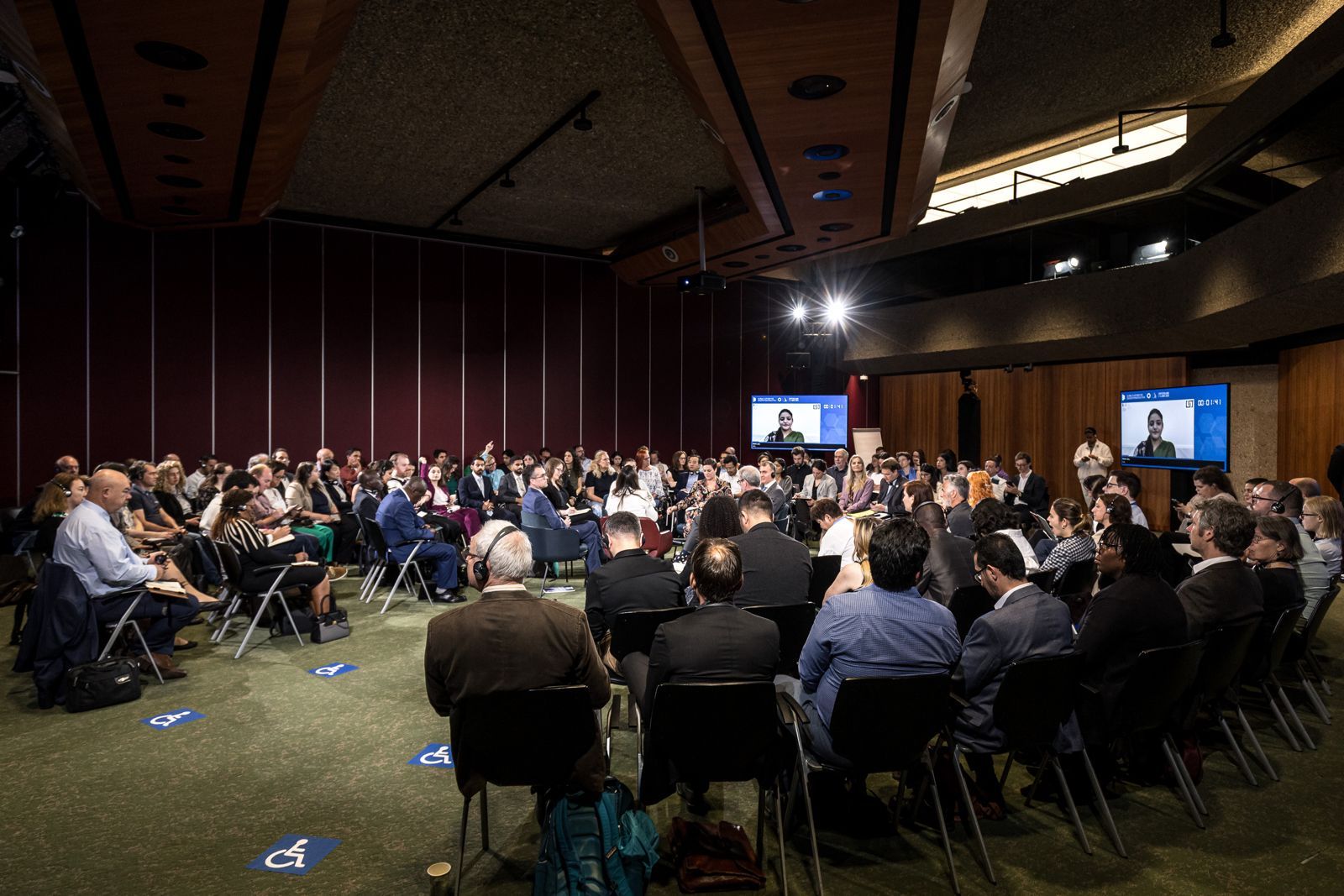
GPDRR 2025
Indigenous knowledge & place-based wisdom, rooted in long-term observation and adaptation to local environments, provides deep insights into how ecosystems, communities, and economies have historically responded to stressors and shocks. This wisdom often uncovers hidden vulnerabilities and interdependencies that might not be evident through data alone.
Meanwhile, science and technology offer powerful tools like modelling, data analysis, and prediction to quantify risks, simulate scenarios, and pinpoint potential tipping points within and across systems – system of systems.
By combining these strengths, we get a more complete picture: indigenous knowledge adds contextual depth to scientific models, while technology scales these insights for wider application.
This is exactly what our Co-Founder Sriparna Sil deliberated upon in #GP2025 and has been aptly captured in the summary here – https://globalplatform.undrr.org/news/gpdrr-2025-highlights-wednesday-4-june-2025
The session was absolutely insightful with experts pouring in their observations and experiences on the systemic nature of risk and how it should / could be better understood and managed! In case you have missed it, here’s the link – https://www.youtube.com/live/rP0nzFVcSuM
UNESCO Global Report on Cultural Policies
We are absolutely delighted to announce that the “Lessons from Jodhpur: Putting Indigenous Knowledge and Place-Based Wisdom to Practice”, acquired from our year-long intervention has found its rightful place in the Encyclopedia of Disaster Risk Reduction!
In this era which trends on #AI and #ML, this study puts the focus back on how indigenous knowledge is vital to fully harness the potential of existing resources (community based natural resource management, #CBNRM) for sustainable development and climate adaptation.
In fact, the study posits that integration of modern science with indigenous knowledge and place-based wisdom, along with a people-centric, inclusive approach, is essential to enhance community resilience and develop practical solutions.
Congratulations Jeevan for taking the lead on this one, along with Sriparna and Repaul!
If this is of interest, you can read here
Access report here – https://link.springer.com/rwe/10.1007/978-981-97-4547-0_233-1
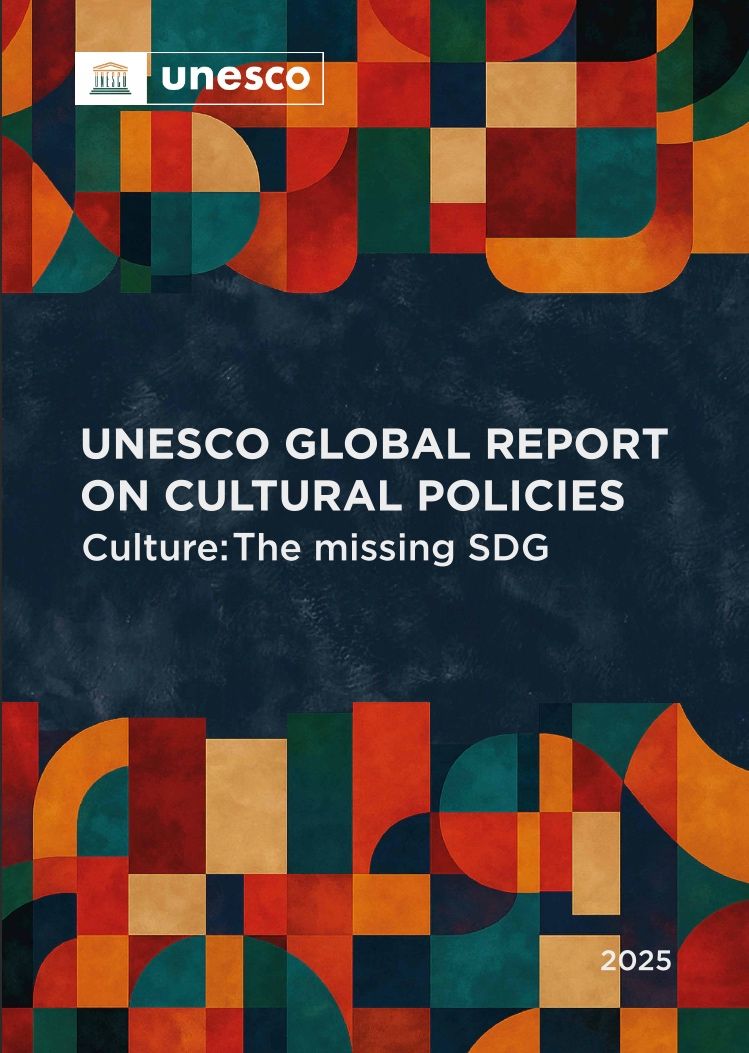
UNESCO Global Report on Cultural Policies
The UNESCO Global Report on Cultural Policies offers the first-ever comprehensive overview of cultural policies worldwide, drawing on data from 196 countries and 100+ cities.
Rooted in the vision of the MONDIACULT 2022 Declaration, the Report is a collective roadmap for action — showing why culture must be recognized not only as a powerful means but also as a vital end in itself.
Our co-founder, Repaul Kanji, had the enriching opportunity to peer review this report! The content of the report is pretty much aligned to what we at GRRID Corps have been trying to establish through practical evidences in some of our projects!
Access report here – https://unesdoc.unesco.org/ark:/48223/pf0000395504
Futures Thinking and Strategic Foresight in Action
This paper documents the outcomes of a year-long intervention designed to address climate challenges in Jodhpur, India. The intervention employed a phased approach that combined traditional knowledge, innovative communication strategies and youth engagement. The question guiding the interventions was: Can traditional knowledge, indigenous practices and place-based wisdom be used for risk-informed sustainable development?
Access paper here – https://www.emerald.com/jchmsd/article/14/5/787/1234545/Culture-for-climate-action-in-Jodhpur-reversing
Futures Thinking and Strategic Foresight in Action
We are psyched to announce our Co-Founder Repaul Kanji‘s latest contribution in the report brought out jointly by the United Nations Futures Lab and the International Science Council on “How is the Global South shaping the future of governance, innovation and resilience in a long-term, anticipatory manner?”
Futures thinking and strategic foresight are key to helping us address complex issues and deal with significant uncertainty – and to embedding long-term perspectives that consider policy implications on future generation. There is a growing acknowledgement of the need to transform current approaches to policymaking and decision-making to become more future oriented in support of anticipatory action and building long-term resilience.
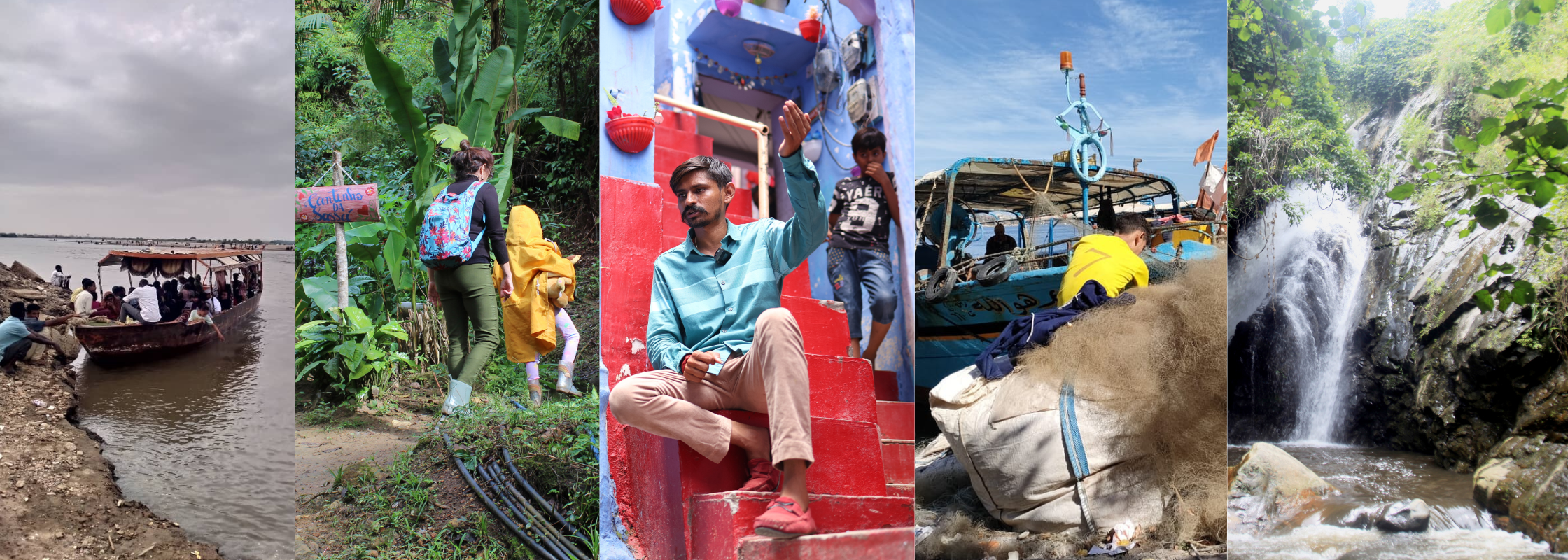
Through our case, we elaborate on how disaster risk governance can be strengthened at hyperlocal levels by engaging women in climate action and disaster risk reduction!
Full report here – https://un-futureslab.org/project/futures-thinking-and-strategic-foresight-in-action-insights-from-the-global-south/

Gender Just Climate Solutions Award ’24
Our intervention, Sanchay/CulTool, has been nominated and featured for the #GenderJustClimateSolutions award at @cop29_azerbaijan, out of a staggering 343 entries, by the @wecf_international and @wgc_climate.
Full report here – https://www.wecf.org/wp-content/uploads/2024/11/WECF_GJCS_9th-edition_2024-1.pdf

World Cities Report ’24
Our intervention is adopted and featured in the World Cities Report of 2024.
Full report here – https://unhabitat.org/world-cities-report-2024-cities-and-climate-action
Culture for climate action in Jodhpur: reversing the trajectory from fragility to resilience
An evidence based academic account of our intervention from Jodhpur.
Read here – https://www.emerald.com/insight/content/doi/10.1108/JCHMSD-04-2024-0076/full/html

ARC 3.3
Our work at the crossroads of urban development & sustainability through traditional knowledge finds place in ARC 3.3
Read here – https://www.preventionweb.net/publication/transformative-adaptation-case-jodhpur-india

India NbS Forum
Our year long work in Jodhpur which is evidence enough for policy-makers to think of integrating nature-based solutions in development agenda was acknowledged.
Read here- https://unhabitat.org/wcr/
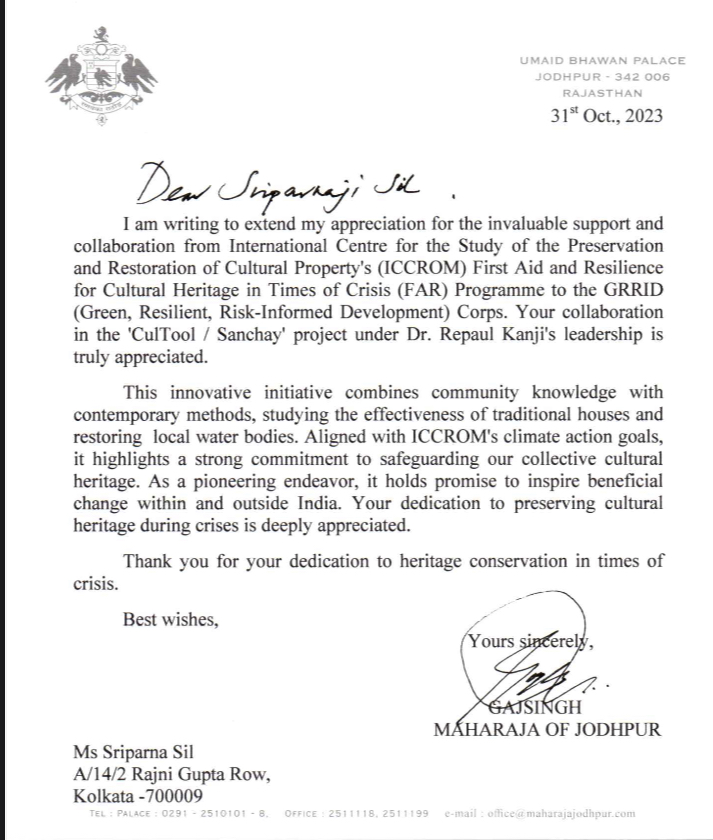
Royal Acknowledgement
The Maharaja of Jodhpur, His Excellency, Gaj Singh II, acknowledged the extensive work we had done in the old city of Jodhpur, weaving together traditional knowledge and advanced science for disaster risk reduction and climate action.
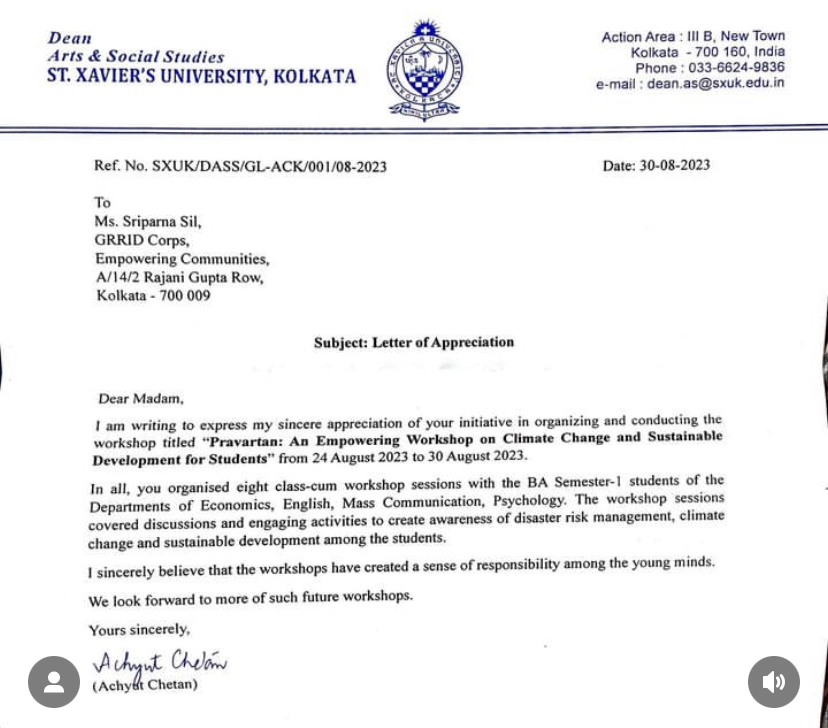
Capacity Building of Children and Youth
We organised a focussed and customised capacity building workshop for the students of the St. Xavier’s University, Kolkata.
Coming from diverse backgrounds and fields, we managed to inspire a good number of the young minds to think and act against the changing climate and the ever-increasing riskscape.
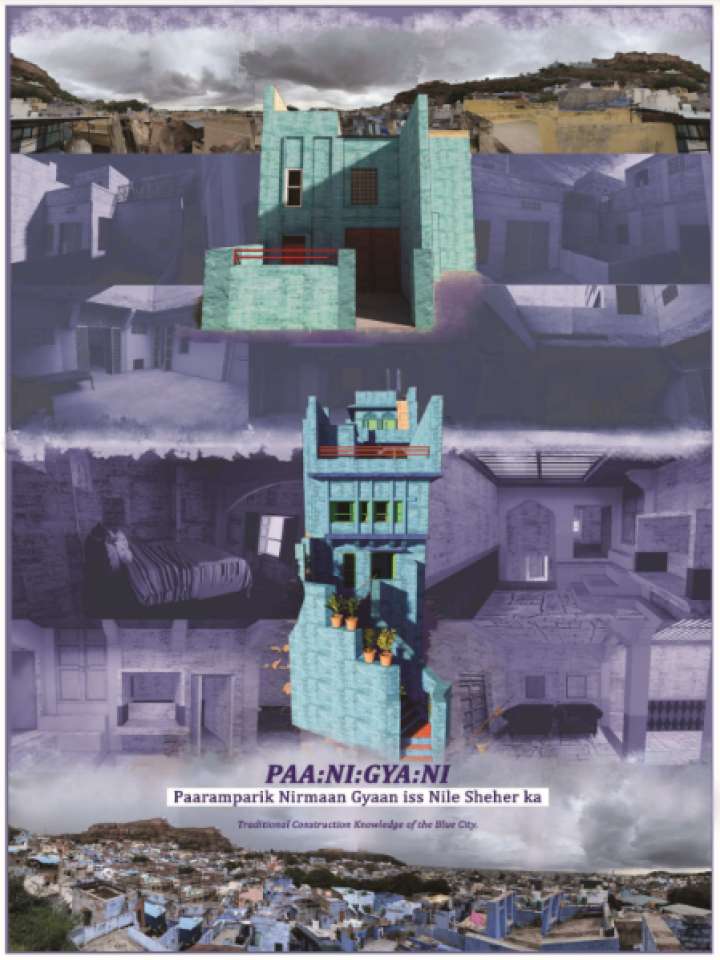
Traditional construction knowledge of the Blue City (Jodhpur): Paving way for a cooler future
By delving into the anatomy of traditional houses in Jodhpur, this report offers valuable insights which can be incorporated into contemporary building practices, creating a more sustainable and climate-resilient Jodhpur and cities around the world.
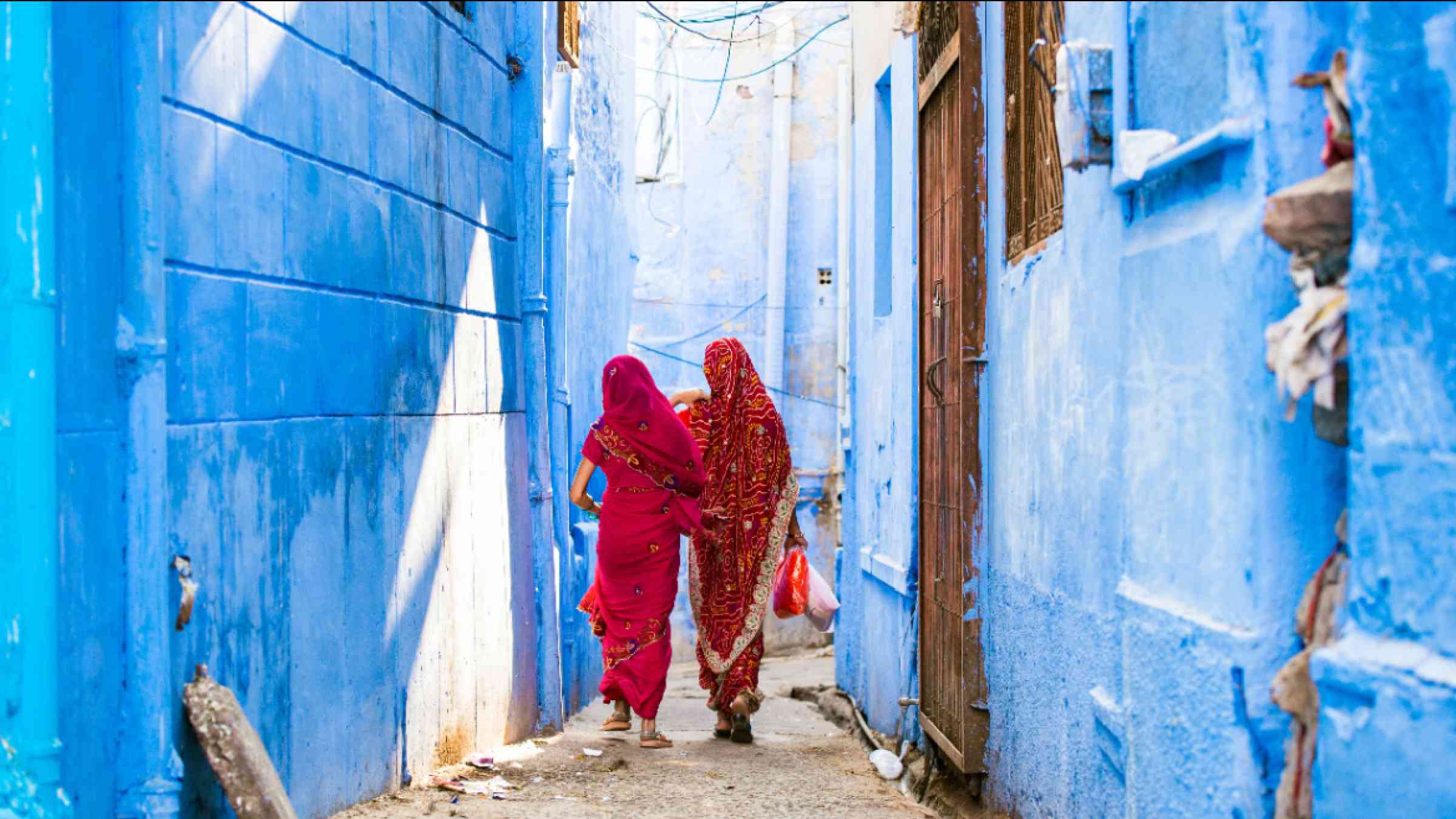
Traditional wisdom for a cooler future
Not always does a scientific account help in understanding the nerve and fabric of a community. In such cases, a frank blog helps.
Read here – https://www.preventionweb.net/drr-community-voices/blue-houses-jodhpur-traditional-wisdom-cooler-future

Is this our future?
How do you inspire children and the youth to take up the responsibility of risk-informed & sustainable development, where they do not feel burdened by the magnanimity of the task?
Watch here – https://youtu.be/EhadgTEb_1Y?si=6Du2DI-GhNbKt-9t

Climate Intelligent Construction Practices: Lessons from the past
While we all embark on the mad bandwagon of embracing the contemporary developments. it would be wise to see (visualise) how beneficial (& scientific) traditional ways of life were!
Watch here – https://youtu.be/Arxkdq2AzB0?si=CoUfvonPVcOxKS3K

The Climate-Culture Story: Sanchay
behold India’s first audio-visual illustration of a riskscape of a city, produced by weaving together opinion and perceptions of the city’s residents.
Watch here – https://youtu.be/Arxkdq2AzB0?si=CoUfvonPVcOxKS3K
Our Partners & Collaborators
In a very small span of time, we have been able to partner and collaborate with multiple organisations; ranging from INGOs to community based organisations!
We are glad that we are steadily growing!